The first step to recovery is a powerful one, but it often raises the question, “Which type of rehab will I need to give me long-term sobriety?
When choosing a recovery path, it’s important to know the different types of treatment that work best for you. The correct care structure certainly plays a significant role in your long-term retention and success rates. There are two mainstays of addiction treatment: inpatient (residential) rehab and outpatient care.
Our MD Rehab goal is to help you or your loved one make an informed, confident choice for lasting wellness.
| Key takeaways Inpatient rehab lasts from 30–90 days and involves 24/7 residential care for people with severe addiction, who are at risk of withdrawal or have an unstable home environment. Patients who are treated via outpatient rehab, however, will receive this structured treatment while living at home. The right option can depend on ASAM criteria. |
What Is Inpatient Rehab?
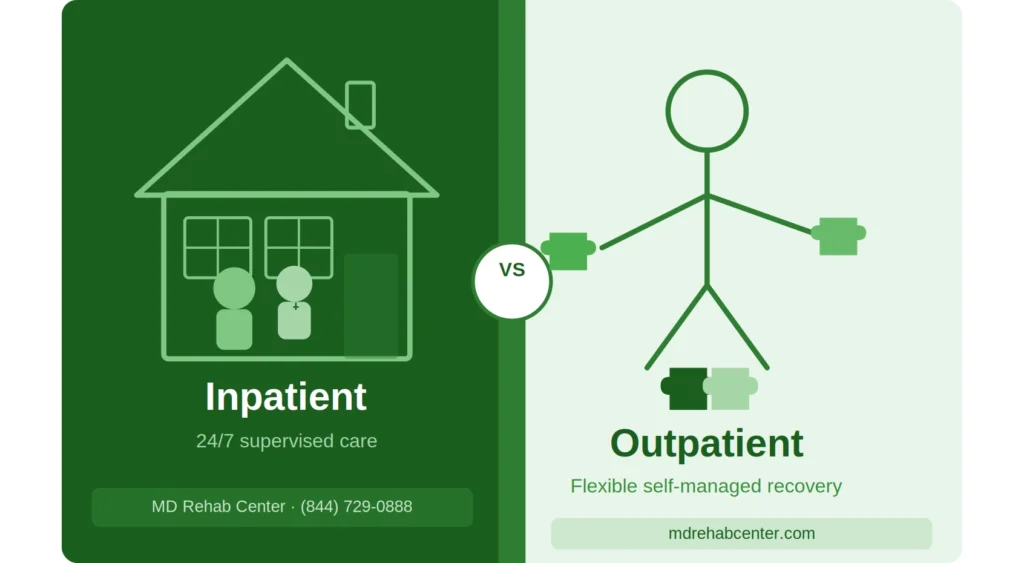
Inpatient rehab, sometimes referred to as residential treatment, requires full-time residential live-in improve quality care where the patient resides in the treatment facility.
No evenings at home, no drive from session to session; no more going home between appointments. The patient is taken completely out of their daily environmental triggers and receives 24-hour clinical, medical and peer guidance.
Inpatient programs last for 28 to 90 days, but may last for six months or a year if the patient has a complicated history. You follow a daily schedule that is both rigorous and intensive: individual therapy, group sessions, family programming, round the clock medical monitoring, psychoeducational classes and wellness services.
What Happens Inside Inpatient Rehab?
The initiation of inpatient treatment involves a full assessment with an extensive clinical evaluation involving queries about relevant substance use history, past and present physical health-related issues.
A typical inpatient day includes:
- Daily check-in with nursing or counseling staff.
- Psychotherapy (CBT, DBT, trauma-informed care, or Motivational Interviewing)
- Sessions with peers focused on coping skills, relapse prevention and accountability
- Medication management & medical monitoring (including MAT if applicable)
- Psychoeducation Classes on Addiction Science, Brain Chemistry, and Recovery
- Family therapy sessions are usually held once a week to overcome family challenges.
- Evening wellness programming
- Attending 12-step or other peer support meetings
Types of Inpatient Programs
Short-Term Residential (ASAM Level 3.3 / 3.5)
Short-term residential treatment classes commonly last for 28–30 days. They are suitable for treating moderate-to-severe addiction in patients who need to step out of their embeddedness in a home environment but not into the more restrictive medical care of detoxification. This is the most common type on-going residential treatment in the US.
Long-Term Residential (ASAM Level 3.5)
Short-term programs are 5–30 days, while long-term programs run 60-90 days or more. Research well-documented in the literature indicates that longer treatment duration is related to positive long-term recovery outcomes.
Medically Managed Inpatient (ASAM Level 4.0)
This is also the highest level of care in the ASAM continuum. It is used when patient needs round-the-clock supervision and physician-level medical management, which carry risks of life-threatening seizures and delirium tremens. It is provided in a hospital-based or medically staffed inpatient setting and serves as the transition between acute medical care and residential rehabilitation.
Ready to Break the Cycle? Discover How Our Compassionate Inpatient Rehab Programs Can Help You Reclaim Your Life Today
What Is Outpatient Rehab?
Outpatient rehab is an addiction treatment that takes place in a structured format where the patient lives at home (or sober living housing) while attending scheduled sessions at a clinic or facility. This is different from an inpatient treatment, as the patient returns to their surrounding area in between routines. No sleep away, no residential element, and not taking away the patient from their everyday living.
On the higher end, Partial Hospitalization Programs require almost a full day of treatment, five to seven days per week.
In other words, at the low end, standard outpatient therapy could consist of two individual therapy sessions a week. The common feature of every outpatient care service is that the treatment is not continuous in nature but is scheduled and time-bound.
What Happens in Outpatient Rehab?
Outpatient treatment used most of the same therapeutic modalities as inpatient services, including individual therapy, group sessions, medication management, family programming and peer support.
The key difference is that these services are packed into scheduled time slots rather than integrated into a 24 hour array.
Outpatient treatment relies heavily on practical relapse-prevention skills working in real-world environments because it is offered while patients go home each day.
Main Differences Between Inpatient and Outpatient Rehab
The table below covers the eight most clinically significant differences between inpatient and outpatient rehab.
| Factor | Inpatient Rehab | Outpatient Rehab |
| Living Arrangement | 24/7 residential (lives at the facility) | Lives at home or in sober living housing |
| Treatment Intensity | Full-day structured programming | Several hours/day to a few hours/week |
| Typical Duration | 28–90 days (some programs up to 12 months) | PHP: 3–6 weeks; IOP: 8–12 weeks; OP: ongoing |
| Medical Supervision | Continuous nursing and physician access | Available during scheduled sessions only |
| Environment Control | High — patient removed from triggers | Low — patient returns home daily |
| Work/Family Maintained | No — full immersion in treatment | Yes — especially at IOP and standard OP levels |
| Average US Cost (Uninsured) | $14,000–$27,000+ per 30-day stay | $3,000–$10,000+ depending on intensity level |
Note: Cost figures are general US market estimates and vary by location, facility type, and insurance coverage. Always confirm specific costs directly with the treatment facility.
Who May Need Inpatient Treatment?
Inpatient rehab isn’t merely the “more secure” choice for everyone; this is the medically indicated option for certain patients according to their condition. Clinicians utilize structured assessment instruments, such as the ASAM criteria, to identify those patients for whom outpatient care will no longer be safe or support significant recovery.
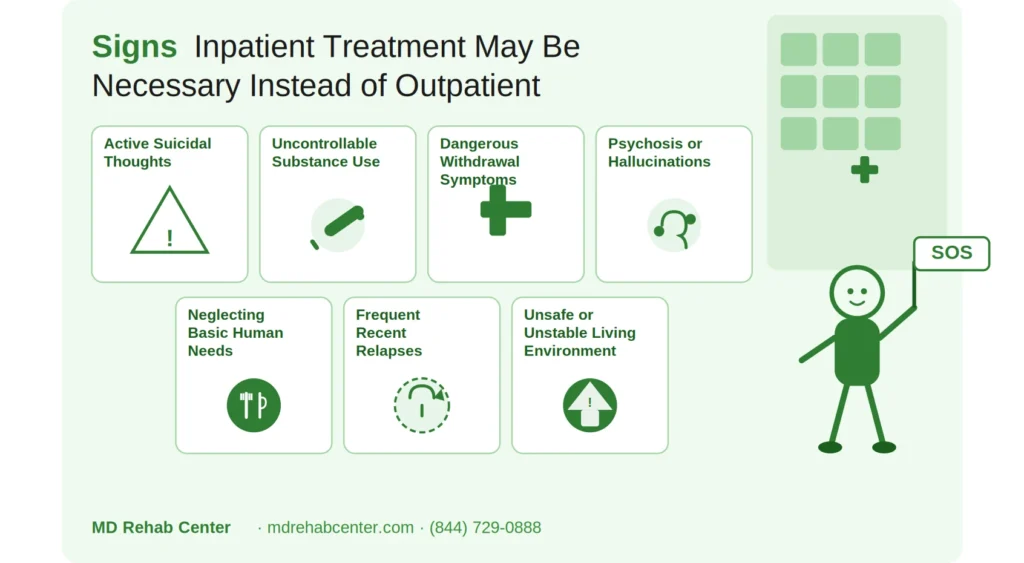
The following clinical indicators commonly point toward inpatient placement.
1. Severe Physical Withdrawal Risk
2. Repeated Attempts at Lower Levels of Care
3. Unstable or High-Risk Home Environment
4. Co-occurring Psychiatric Disorders (Dual Diagnosis)
5. Lack of Social Support for Recovery
6. Polysubstance Dependence
Who May Choose Outpatient Treatment?
Outpatient rehab is a less committed form of treatment. For the right patient, outpatient (above all, PHP or IOP) has equivalent treatment results to inpatient care and allows the individual to keep his/her responsibilities, social roles, and daily life. The key is proper patient selection.
1. Mild to Moderate Addiction Severity
2. Stable, Substance-Free Living Situation
3. Strong Social Support System
4. Employment, School, or Caregiving Responsibilities
5. Transitioning Down from Inpatient
6. Motivated and Clinically Stable
Take Control of Your Well-Being Without Pausing Your Responsibilities
See If Our Outpatient Care Is the Right Fit for You
Cost Differences Between Inpatient and Outpatient Rehab
Cost is the most frequently cited barrier to treatment access and one of the most frequently misunderstood aspects of rehab. The correct question is not simply “what does it cost?” but “what does it cost after insurance, and what is the ongoing cost of not treating this condition?”
Inpatient Rehab Costs
Inpatient rehab includes housing, food, 24-hour staffing, medical services and all modalities of therapy/programming as one residential service. This consolidation earns you at a higher price basis.
| Program Type | Typical Duration | Estimated Cost (Uninsured, US) |
| Short-term residential (28 days) | 28–30 days | $14,000–$27,000 |
| 60-day residential | 60 days | $25,000–$50,000+ |
| 90-day residential | 90 days | $30,000–$60,000+ |
| Luxury / executive inpatient | 30–90 days | $50,000–$100,000+ |
Outpatient Rehab Costs
| Program Type | Typical Duration | Estimated Cost (Uninsured, US) |
| Partial Hospitalization (PHP) | 3–6 weeks | $3,500–$8,000 |
| Intensive Outpatient (IOP) | 8–12 weeks | $3,000–$6,000 |
| Standard Outpatient (OP) | 12+ weeks / ongoing | $1,000–$2,500 |
These are uninsured estimates. Always contact your insurance provider and the treatment facility before assuming cost is a prohibitive barrier.
Insurance Coverage for Each Option
Most health insurance plans have to provide substance use disorder treatment at parity with medical and surgical benefits, according to the Mental Health Parity and Addiction Equity Act (MHPAEA). Under the law, insurers cannot have stricter treatment limits on addiction care than they do for comparable physical health conditions.
However, in practice, coverage is based on your own specific plan, if that site is not already in network for you, and whether the necessity of receiving the medical procedure at all was documented. Before signing up for treatment, every patient & their family must understand the following
What Most Insurance Plans Cover
- Medically necessary detoxification (inpatient or outpatient)
- Inpatient and residential rehab (subject to prior authorization and medical necessity review)
- Partial Hospitalization Programs (PHP)
- Intensive Outpatient Programs (IOP)
- Standard outpatient therapy and medication-assisted treatment (MAT)
- Psychiatric evaluation and medication management for co-occurring disorders
PHP vs. IOP vs. Standard Outpatient Care
Outpatient treatment is an entire ‘branch’ rather than a single program, so just picking “outpatient” is only the first part of your choice. The next piece is what level of outpatient intensity is clinically meaningful. To properly recommend (or review a recommendation) for treatment, it is important to understand the fundamental differences between PHP, IOP, and standard outpatient.
You Deserve a Treatment Plan That Works for You
Contact Us Today to Find the Right Level of Care for Your Recovery
Partial Hospitalization Program (PHP)
PHP is the highest level of outpatient treatment. Also known as “day treatment,” this resembles the full structure of inpatient programming minus the sleeping. Patients usually go to treatment five to seven days per week for four to six hours a day. You will have individual counseling, group counseling, medical evaluations, psychiatric assessments, psychoeducational materials, and family sessions.
ASAM Level: 2.5 (Partial Hospitalization / High-Intensity Outpatient)
PHP is clinically appropriate when:
- The patient has completed inpatient detox but still requires significant daily structure
- Psychiatric symptoms are present but sufficiently stable for home-based living
- Housing is stable, and the home environment supports recovery
Intensive Outpatient Program (IOP)
IOP offers a lower level of intensity than PHP. Patients receive treatment three to five days a week, about three hours per session. This is why sessions are often scheduled for morning or evening during weekdays to allow working adults to attend. Programming emphasizes behavioral therapy, relapse prevention skills, group accountability (for example, with the 12 steps), life skills and medication management when appropriate.
ASAM Level: 2.1 (Intensive Outpatient)
IOP is clinically appropriate when:
- Moderate addiction with no need for taking a medication every day.
- Work, school, or caregiving commitments render all-day programming unfeasible
- The patient is stepping down from PHP or inpatient care.
- This patient has completed the primary treatment course, but requires organized management of care thereafter.
Standard Outpatient Program (OP)
Standard outpatient treatment typically includes the least intensive level of treatment, where you have one to three individual or group therapy sessions a week. Individual therapy sessions are typically 45–60 minutes, while group is 60–90. It is indicated for mild addiction during the maintenance phase of treatment after higher-intensity treatment or as ongoing continuing care for patients who are in stable, sustained recovery.
ASAM Level: 1.0 (Outpatient Services)
PHP vs. IOP vs. Standard Outpatient — Side-by-Side
| Feature | PHP | IOP | Standard OP |
| ASAM Level | 2.5 | 2.1 | 1.0 |
| Days per Week | 5–7 | 3–5 | 1–3 |
| Hours per Day | 4–6 hours | 3 hours | 1–2 hours |
| Lives At | Home or sober living | Home or sober living | Home |
| Medical Monitoring | Available during sessions | Limited | Minimal |
| Work-Compatible | Difficult | Yes (morning/evening) | Yes |
| Typical Duration | 3–6 weeks | 8–12 weeks | 12+ weeks / ongoing |
| Best Step For | Post-detox / post-inpatient step-down | Moderate addiction / working adults | Long-term maintenance |
How Clinicians Use ASAM Criteria to Determine Level of Care
The American Society of Addiction Medicine (ASAM) criteria are the gold standard for patient placement in addiction treatment across the United States. They are used to guide decisions about initial placement, continued stay, transfer between levels of care, and discharge planning. Most accredited treatment facilities use some version of the ASAM criteria, either directly or through assessments built on the same framework.
The wrong level of care. Many people come into treatment at the wrong level of care. They are put in outpatient when they clinically require inpatient, either because inpatient is not an option due to cost or the patient or family will fight against the disruption.
That’s the reason ASAM criteria even exist to avoid such mistakes. They provide a value-neutral, clinically-driven framework for placement decisions that is not influenced by availability, insurance pressure, family request or financial motivation.
The Six ASAM Dimensions
Dimension 1 — Acute Intoxication and Withdrawal Potential
Is the patient currently intoxicated? Is there a significant risk of life-threatening or severe withdrawal if the substance is discontinued? Does the patient need medically supervised detoxification?
Dimension 2 — Biomedical Conditions and Complications
Are there physical health conditions that could complicate treatment or require medical attention during the recovery process? This includes liver disease, cardiovascular conditions, HIV/AIDS, chronic pain, or any other comorbidity that needs active management alongside addiction treatment.
Dimension 3 — Emotional, Behavioral, and Cognitive Conditions
Are co-occurring mental health disorders present, such as depression, anxiety, PTSD, bipolar disorder, or schizophrenia? Is there psychiatric instability, cognitive impairment, or behavioral dysregulation that requires clinical management? This dimension is the basis for dual diagnosis placement decisions.
Dimension 4 — Readiness to Change
Where is the patient on the motivational spectrum? Are they pre-contemplative (not yet acknowledging the problem), contemplative (recognizing it but ambivalent), or in preparation/action (actively seeking change)? This dimension informs the therapeutic approach, not just the placement level.
Dimension 5 — Relapse, Continued Use, and Continued Problem Potential
What is the likelihood of relapse without structured support? Are there strong cravings, inadequate coping skills, high-risk use patterns, or a history of multiple treatment episodes? This dimension directly informs how much external structure and clinical monitoring are required.
Dimension 6 — Recovery and Living Environment
Are family members using substances? Is housing stable? Are there legal, employment, or social stressors that will undermine outpatient treatment? This is one of the most decisive dimensions in the inpatient vs. outpatient decision.
Ready to Reclaim Your Life? Connect with Our MD Rehab Treatment Expert Today
Call today, and our caring admissions specialists are standing by to provide you with a confidential assessment, insurance verification, and referral to the best quality inpatient or outpatient programs that fit your specific life situation.
What to Do Next
Choosing between inpatient and outpatient rehab is not a decision that should be made based on a single article. The right level of care emerges from a proper clinical assessment, conducted by a licensed professional who can evaluate the medical status, psychiatric history, addiction severity, living environment, and readiness to change.
What this guide can do is help you walk into that conversation informed. You now understand the distinctions between every level of care, the clinical criteria that guide placement, and the questions worth asking.
So don’t wait for the right moment, make this moment right and contact our admission center!
What is the main difference between inpatient and outpatient rehab?
The primary difference is where you live during treatment. Inpatient rehab requires you to reside at the treatment facility 24 hours a day, while outpatient rehab allows you to live at home and attend scheduled treatment sessions.
How long does inpatient rehab last?
Most inpatient programs run 28 to 90 days. Short-term residential programs typically last 28–30 days. Long-term residential programs can extend to 6–12 months for individuals with severe, chronic histories.
How long does outpatient rehab last?
Duration depends on the level of care. PHP (Partial Hospitalization Programs) typically last 3–6 weeks. IOP (Intensive Outpatient Programs) typically last 8–12 weeks.
What is PHP in addiction treatment?
PHP is the most intensive level of outpatient care, typically involving 5–7 days per week of treatment, 4–6 hours per day.
Does insurance cover inpatient rehab?
Yes. Most health insurance plans cover inpatient rehab when it is deemed medically necessary.
What happens if someone leaves inpatient rehab early?
Leaving inpatient treatment against medical advice (AMA) significantly increases relapse risk.
What is the success rate of inpatient vs. outpatient rehab?
Direct success rate comparisons are difficult to interpret because programs define and measure outcomes differently, and patient populations vary widely.