Overcoming a substance use disorder requires more than just willpower; it demands a comprehensive, medical approach that addresses how addiction changes brain chemistry.
Medication-Assisted Treatment (MAT) uses FDA-approved medications in conjunction with behavioral therapies to safely maintain recovery. This data-driven approach balances both the body and mind, giving you or your loved ones to escape active addiction.
Our MD Rehab Center offers a specialized clinical team to provide the medical and psychological support necessary for each patient on their path of long-term, sustainable sobriety.
| Key Takeaways Medication assisted treatment (MAT) is the use of FDA-approved drugs, counseling and behavioral therapies for the treatment of opioid use disorder and alcohol use disorder. According to the National Institute on Drug Abuse (NIDA) these three primary MAT medications methadone, buprenorphine, and naltrexone, relieve cravings, alleviate withdrawal and decrease risk of relapse and death from overdose. |
What Is Medication Assisted Treatment?
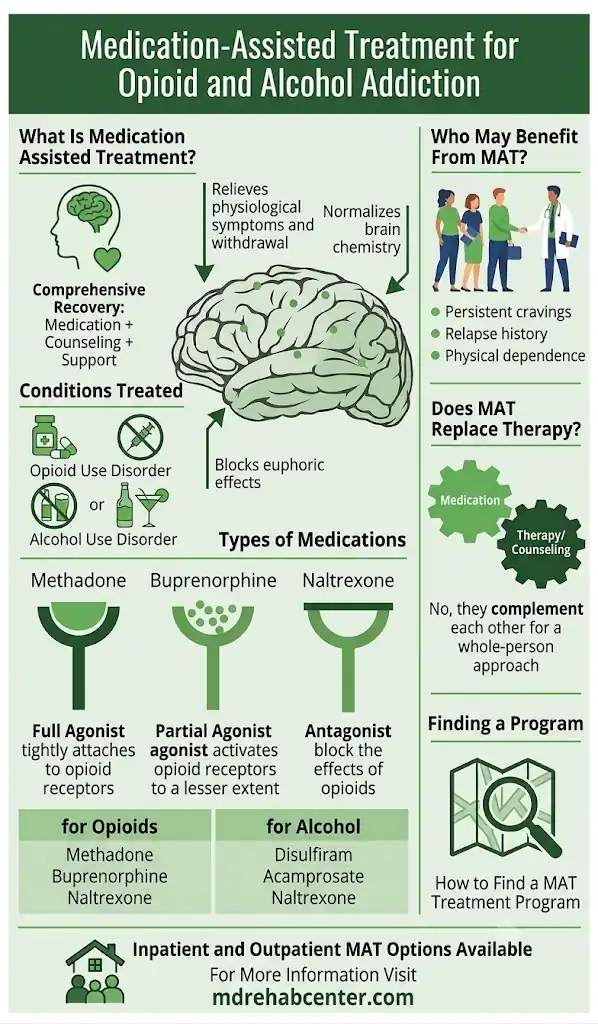
Medication assisted treatment (MAT) is a form of evidence-based intervention commonly used for opioid use disorder (OUD), and alcohol use disorder (AUD), the main component of which includes FDA-approved medications in combination with counseling and behavioral therapies.
| According to the Substance Abuse and Mental Health Services Administration (SAMHSA) defines MAT as the use of medications, in combination with counseling and behavioral therapies, to provide a whole-patient approach to the treatment of substance use disorders. |
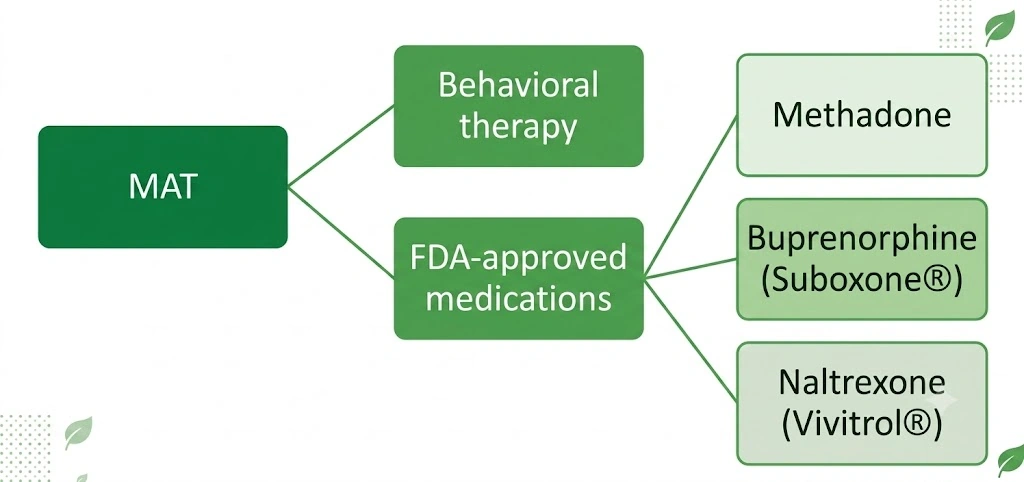
According to NIDA, there are three FDA-approved medications for treating opioid addiction. They are methadone, buprenorphine, and naltrexone and they can help reduce or stop opioid use and help a person remain engaged in treatment.
All three types of medicine operate on the same opioid receptors activated during an illicit drug, but with a pharmacological method that stops euphoria and decreases cravings (and cognitive system) along with interfering-with-premature withdrawal signs and symptoms.
What conditions does MAT treat?
- Opioid use disorder (heroin, prescription painkillers, fentanyl)
- Alcohol use disorder
- Co-occurring opioid and alcohol dependence
Who May Benefit From MAT?
MAT is appropriate for most severe cases. Many treatment providers recommend it as a first-line approach for opioid use disorder specifically, given how dangerous withdrawal and relapse can be in the context of today’s fentanyl-contaminated drug supply.
MAT may be a strong fit if you or your loved one:
- Has opioid use disorder or alcohol use disorder
- Has a history of unsustainable abstinence-oriented treatment
- Experiences intense urges or withdrawal symptoms that make abstinence hard
- Past opioid overdose experience
- Is a pregnant woman and requiring a more secure option for mother and child
- Has a concomitant mental health disorder (dual diagnosis), which complicates recovery
- Required to work or look after family while in treatment (outpatient MAT)
How its work?
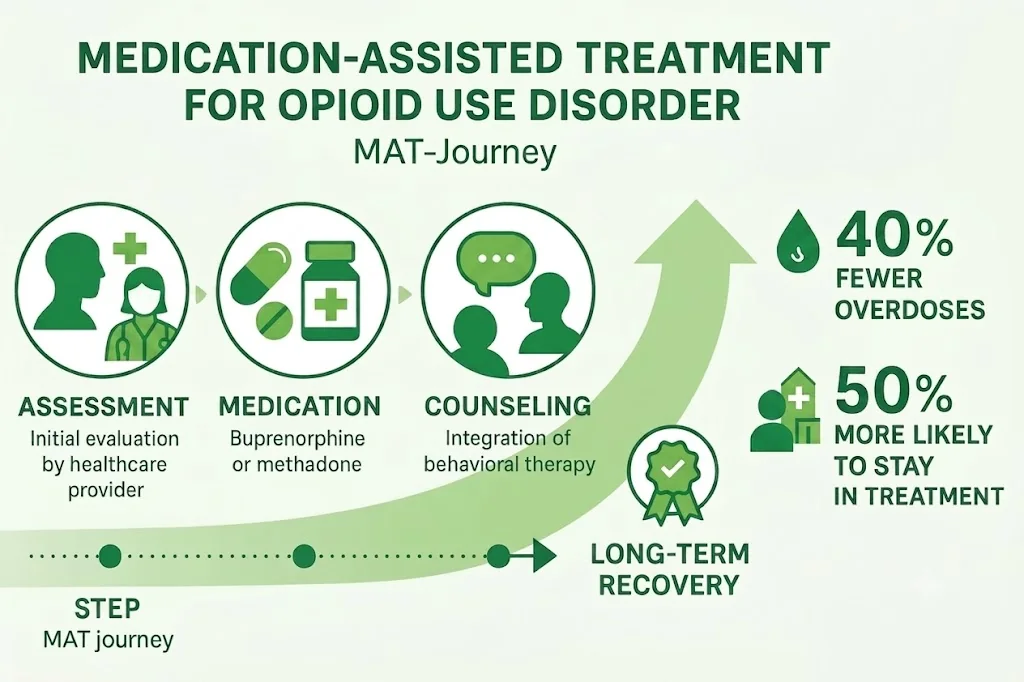
Prior to beginning actual MAT medication, you will be medically evaluated by a licensed clinician. The ASAM criteria are widely used to determine the level of care appropriate for the individual patient, whether inpatient residential treatment with medication support or an outpatient MAT program.
MAT is commonly used for those with dual diagnosis potentially co-occurring mental health conditions and addiction. You can find out about our approach to dual diagnosis care with the right hands.
Are you ready to take a Medication Treatment approach at MD Rehab Center
You or your loved ones can access inpatient and outpatient MAT with integrated therapy at MD Rehab Center. Verify your insurance, ask about your medication options, and speak with a real person
MAT for Opioid Use Disorder
Opioid addiction is now more perilous than ever with the introduction of illicitly manufactured fentanyl into the drug supply. MAT for opioid addiction treatment relies on three FDA-approved medications.
Buprenorphine (Suboxone, Subutex, Sublocade)
Buprenorphine is a partial opioid agonist: It binds to opioid receptors in the brain, but it has much less effect than stronger opioids (those that are considered “full” agonists, e.g., heroin or oxycodone). It exhibits a property called the “ceiling effect” that means it is much less likely to kill you, even at high doses on its own.
| Detail | Information |
| Brand Names | Suboxone (buprenorphine/naloxone), Subutex, Sublocade (injectable) |
| Form | Sublingual film, sublingual tablet, monthly injection |
| Who Prescribes | Office-based physicians, addiction specialists, NPs, PAs with waiver |
| Best For | Outpatient MAT, patients who want flexibility and privacy of a doctor’s office setting |
| Key Advantage | Does not require daily clinic visits; can be taken at home |
| Naloxone Component | Suboxone includes naloxone to deter injection misuse |
Methadone
Methadone is a well-known full opioid agonist that has been employed in the treatment of patients suffering from opioid use disorder since the 1960s. It is a strong medication and can lead to overdose if misused.
In the correct dosage and if taken as prescribed, however, it is especially good at eliminating cravings and preventing withdrawal so patients can be stabilized on treatment before entering counseling.
| Detail | Information |
| Form | Oral liquid (dispensed at clinic), diskettes, tablets |
| Where Dispensed | Federally certified Opioid Treatment Program (OTP) / methadone clinic |
| Best For | Severe opioid dependence, patients who benefit from daily structure, those who have not responded to buprenorphine |
| Key Advantage | Long half-life keeps withdrawal symptoms at bay for 24–36 hours; highest evidence base of any MAT medication |
| Key Consideration | Requires daily clinic visits initially; not suitable for patients far from an OTP |
Naltrexone (Vivitrol) for Opioid Use Disorder
Naltrexone is an opioid antagonist, it completely blocks opioid receptors so anyone who takes an opioid while naltrexone will feel absolutely nothing after taking the dose. This renders an extremely strong antidote to any potential relapse.
Its monthly injectable version, Vivitrol, is especially popular as a once-a-month dose for patients who prefer not to take a daily tablet.
MAT for Alcohol Use Disorder
Alcohol use disorder is a problem in more than 28 million people, but only a small number of them are treated with medication. There are three FDA-approved medication to treat alcoholism which can help decrease drinking, prevent relapse and facilitate recovery in alcohol dependent persons.
| Medication | How It Works | Best For |
| Naltrexone (oral / Vivitrol) | Blocks the reward effect of alcohol; reduces the urge to drink | Patients who want to reduce drinking or achieve abstinence without daily clinic visits |
| Acamprosate (Campral) | Reduces the discomfort and anxiety of early abstinence by restoring brain chemistry balance | Patients focused on maintaining abstinence after detox; especially helpful for those with anxiety |
| Disulfiram (Antabuse) | Creates an unpleasant physical reaction if alcohol is consumed | Highly motivated patients with strong social support who want a behavioral deterrent |
Does MAT Replace Therapy?
No. Medication assisted treatment is not a standalone cure. It is part of a complete treatment plan and works best along with counseling and behavior change support.
Medications on their own are not enough to treat the psychological, social and behavioral aspects of addiction. Therapy gives patients the strategies they need to recognize their triggers, learn how to cope and reconnect in their relationships for long-term success. Medication helps to stabilize the brain chemistry so that therapy can be effective at all.
The behavioral components typically paired with MAT include:
- Individual counseling (cognitive-behavioral therapy, motivational interviewing)
- Group therapy and peer support
- Family therapy and education
- Relapse prevention planning
- Case management and social services navigation
- 12-step or SMART Recovery
MAT Myths and Facts
Stigma is one of the greatest barriers to MAT uptake. Unfortunately, there are a lot of misconceptions surrounding MAT, some of which stem from well meaning family members. Myth-busting is a key part of your informed treatment choice.
MYTH: MAT is just replacing one addiction with another.
FACT: FDA-approved MAT medications are taken at therapeutic doses under medical supervision. Calling MAT “another addiction” is like calling insulin “another dependency” for a diabetic patient.
MYTH: You are not really sober if you are on MAT.
FACT: Long-term recovery is defined by health, functioning, and quality of life not by the absence of any medication.
MYTH: MAT is only for people who cannot handle real recovery.
FACT: MAT corrects measurable changes in brain chemistry. Refusing medication for a brain disease is not strength; it is a medical risk factor.
MYTH: You will have to be on MAT forever.
FACT: Duration varies by individual. Some people taper off successfully after 1–2 years.
Not Sure Whether Inpatient or Outpatient MAT Is Right for You?
Our admissions counselors can walk you through your options, explain insurance coverage, and help you start the process confidentially, with no pressure.
Inpatient and Outpatient MAT Options
Our MD rehab center offer medication assisted treatment in both residential and outpatient settings. The most appropriate environment will depend on the form and severity of the addiction, co-occurring conditions, home environment and practical issues such as work or family commitments.
| Inpatient / Residential MAT | Outpatient MAT | |
| Structure | 24/7 supervised care, on-site medical and therapy staff | Scheduled appointments (daily to weekly depending on phase) |
| Best For | Severe addiction, unstable living situation, previous treatment failures, dual diagnosis | Stable housing, strong social support, moderate-severity addiction, work or family obligations |
| MAT Medications | All three FDA-approved options available; methadone dispensed on-site | Buprenorphine prescribed for home use; naltrexone injection; methadone via OTP |
| Therapy Access | Daily individual and group therapy integrated with medication management | Weekly or bi-weekly therapy sessions alongside medication management visits |
| Duration | Typically 28–90 days for the residential phase; followed by step-down to outpatient | Ongoing; typically 6 months to 2+ years depending on individual progress |
How long does medication-assisted treatment last?
One of the biggest questions people have about MAT is how long do they need to stay on medication. There is not a single answer, this is highly patient specific and should be determined by clinical assessment.
Evidence indicates a high likelihood of both relapse and lethal overdose with the cessation of MAT before long-term use, particularly in OUD. Addiction is such an extreme alteration of brain chemistry that it can take months or even years for the brain to stabilize, and medication supports stabilization during this period.
How to Find a MAT Treatment Program
Finding the right MAT program involves more than a quick online search. The quality of the program, the credentials of the clinical staff, and the integration of medication with therapy all significantly affect outcomes. Here is a practical framework for evaluating your options.
Step 1: Confirm the Program Is Medically Supervised
Step 2: Verify All Three MAT Medications Are Available
Step 3: Ask About Integrated Behavioral Health Services
Step 4: Check Accreditation and Licensing
Step 5: Confirm Insurance Acceptance
Frequently Asked Questions About MAT
What is medication-assisted treatment?
It is a treatment for opioid use disorder and alcohol use disorder that combines FDA approved medications with counseling and behavioral therapies. It is considered the gold standard of care for opioid addiction by NIDA, SAMHSA and ASAM.
How long does medication-assisted treatment last?
Duration varies. SAMHSA says a minimum of 12 months for treatment with buprenorphine and methadone. For patients who get MAT, two or more years of treatment.
What is the difference between MAT and OTP?
MAT (medication-assisted treatment) broadly defines the clinical strategy. An OTP (Opioid Treatment Program) is a federally-certified facility that has been authorized to provide methadone.
What is the success rate of medication-assisted treatment?
Research has shown that MAT decreases the use of opioids by 50% or more, reduces risk for death from overdosing by as much as 50%, and increases treatment retention. The greatest success is seen when medication is combined with extensive behavioral health support.
What are the 12 steps in AA?
The 12 Steps of Alcoholics Anonymous are a spiritual recovery framework addressing admission of powerlessness, belief in a higher power, making amends, and service to others.
Is MAT safe?
Yes, when prescribed and monitored by a licensed clinician.
Does insurance cover MAT?
Most insurance plans are required by the Mental Health Parity and Addiction Equity Act (MHPAEA) to cover MAT. MD Rehab Center can verify your specific benefits before you begin treatment.
Is MAT available in Maryland?
Yes. Maryland has a network of MAT providers like MD Rehab Center that integrate MAT with comprehensive behavioral health services.
Ready to Learn Whether MAT Is Right for You or Your Loved One?
Speak with our clinical admissions specialist at MD Rehab Center. We accept most insurance plans for MAT programs in Maryland.