When you choose recovery from addiction, it can feel overwhelming as if you’re leaving something important, like the essence and routines, the people, and even a part of yourself. The final goodbye can be a source of sadness, similar to the grief felt when losing loved ones.
A lot of people who are in recovery undergo what they call “grieving the death of their addiction. The well-known model of the 5 stages of grief (created by Dr. Elisabeth Kubler-Ross) can help explain these emotions, including anger, denial, bargaining, depression, and acceptance. These stages do not have an absolute rule; they don’t always occur in a sequential order and it is possible to move from one to the other. Knowing them can provide peace and faith. Here at MD Rehab Center, we are with you through every emotion so you can recover fully and remain strong in your recovery.
What Does Grief Mean in Addiction Recovery?
The grief here isn’t just about the loss of someone. It’s about mourning many things all at once:
- The substance felt like a close friend or an escape
- Old friends and places that are tied to the use of
- Your identity was built around addiction
- Time, health, confidence or even the dreams that addiction stole away
You may feel depressed or tired, guilt-ridden, and empty, or even have trouble sleeping. These emotions are normal. If they are not addressed, they could lead to relapses.
This is why we assist you in letting go and dealing with these losses in our MD Rehab Center in order to make healing a part of your rehabilitation and not an obstacle to it.
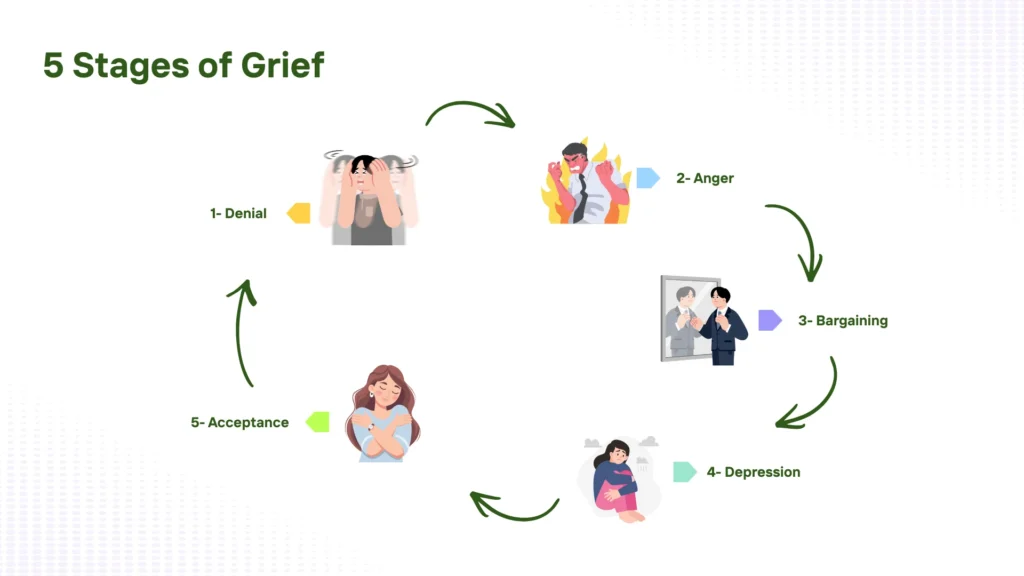
What are the Five Stages of Grief | Explained in Recovery
The five stages created by Elisabeth Kübler-Ross are an ideal framework for understanding the process of healing, as grief sucks. They assist you in recognizing your feelings, help family members, and remain focused on healing.
Stage 1. Denial
In this phase, the mind protects itself by telling itself: “This is not really a problem,” or “I can handle it on my own,” or “I am not like other addicts.”
It is possible to joke about it, stay clear of serious conversations or keep saying that all is fine. Denial is safe, but it does not bring any real change.
In the MD Rehab Center, our helpful team can help to get past the fear of denial by providing friendly discussions and a clear understanding, no judgments, only support.
Stage 2. Anger
The reality begins to hurt, and anger is evident. It is possible to feel angry at yourself (“Why did this occur? “), at family members (“They have never understood me”) or in the universe, and at the idea of sobriety (“Life is dull with it off”).
Anger may manifest as anger, arguments, or blaming others. It’s a regular part of waking up to the reality of.
We provide safe environments for individual sessions and group therapy in which you can vent your anger honestly. By releasing it in this manner, you can prevent relapse.
Stage 3. Bargaining
In this case, the mind attempts to find a compromise “If I just make a few calls now and then …”, “I am going to end it if things improve” or “I will be good if I keep some old acquaintances.”
Bargaining is a way to control something that is not easily controlled. It can lead to “testing” sobriety, which could quickly turn dangerous.
Through cognitive-behavioral therapy (CBT) and mindfulness at MD Rehab Center, we can help you see these thoughts clearly and make healthier choices instead.
Stage 4. Depression
This phase is often the heaviest. The sadness is intense when you face the reality of the loss of your addiction. You may feel helpless or exhausted or even wonder if a clean life is worth the struggle.
A lot of people become more emotional, withdraw from, or cease to be interested in certain things. The risk of relapse is extremely high if your grief is not dealt with.
We can provide extra support here for individuals: one-to-one counseling, dual-diagnosis support (if anxiety or depression are present), Gentle movement such as yoga, and connections with friends who are truly understanding. There is no one to blame in this area.
Stage 5. Acceptance
Then, you arrive at peace. You realize that the old way of life is over, and that’s okay. You begin to feel grateful for your newfound freedom, find meaning, establish changes to your routine, and look ahead with a sense of hope.
Acceptance does not mean you are weak; it shows how strong you are to accept things. It is a way to live entirely without substance. New relationships, joy, and purpose can be achieved.
Our alumni and aftercare groups within the MD Rehab Center help you remain in this stageby celebrating milestones, and encouraging each other in the long run.
Step Into Acceptance & A Sober Future
Five stages of grieving prove the possibility of acceptance, even if you’ve gone through. At MD Rehab Center, we help you reconnect with joy, strengthen relationships, and live life with the confidence you deserve. Contact MD Rehab Center now or visit us to schedule a free consultation. Your new life is only a few steps away.
Important Truth: The Stages Are Not Always Straight
You could skip a step or go backwards, or feel several feelings at once. Stress or even new losses may bring back memories of earlier ones. This is perfectly normal. The process of healing is a journey of understanding your grief, not the equivalent of a race.
There are experts who talk about additional steps such as the “upward turn” (hope begins) or “reconstruction” (building a new life). The most important thing is to be patient with yourself.
Simple Methods to Handle Grief and Stay Sober
- In therapy or support groups, be honest and open with your counselor.
- Record your thoughts in your journal.
- Move your body, Yoga, walks, or gentle exercise can help you release emotions
- Stay connected. Separation can make everything more difficult
- Engage in deep breathing or a brief meditation whenever you feel the need to.
- Beware of old habits and places that can trigger pain
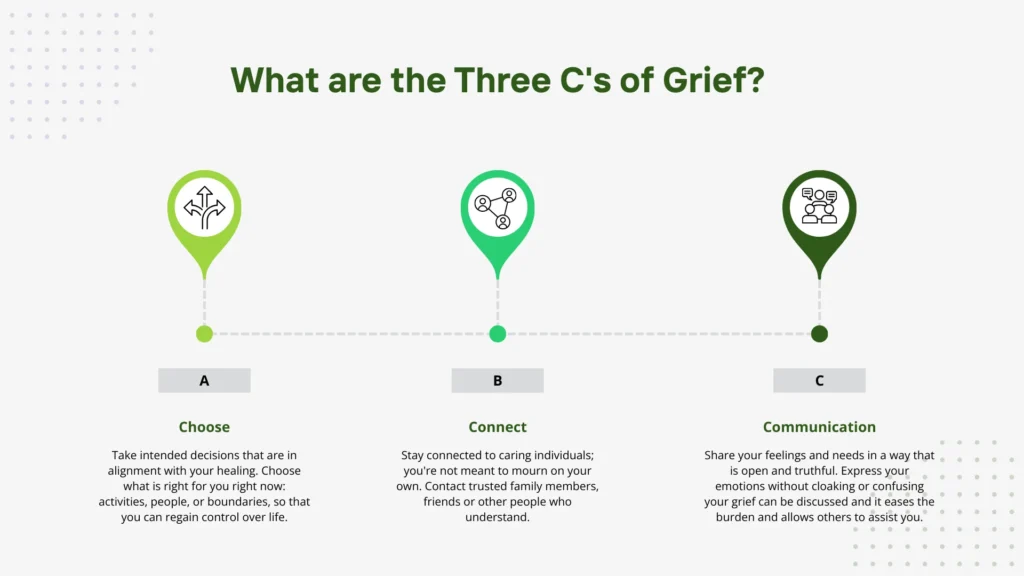
When Should You Ask for More Help?
If you feel very sad or you are contemplating hurting yourself, or your urges are too strong, take action immediately.
There is no need to tackle this issue on your own. We have a team of experts at MD Rehab Center who are trained to assist both addicts and those with emotional pain.
Conclusion
The pain of recovery is real and is normal. It demonstrates how much you are concerned about the process of change. If you are aware of these five phases, you show yourself to be a person of direction and kindness.
You’re already courageous to be here. Acceptance is the key to a life that’s serene, connected and completely yours.
How to Help Someone Who Is Grieving in Recovery
Being there for a loved one during recovery is about being present, without pressure. So our MD rehab center is here to help you reach your recovery goals:
- Our professional is available to listen or assist with a confidential talk.
- Find out what you require. Do not assume that you know everything. Let us guide you.
- We focus on your root causes and first understand your emotions.
Your grieving Journey Starts Today – Don’t Wait Another Day
Are you, or someone you care about, ready to recover from addiction and the pain caused by addiction? MD Rehab Center is there to help with an open heart. Contact us now to make an appointment or complete our easy form. Your new start is waiting. You deserve peace.
What role does grief play in relapse during addiction recovery?
Grief over lost relationships, or even a sense of identity, may cause relapse and often leads to the desire for drugs or emotional trauma, which people used to numb with substances.
How long do the stages of grief typically last in addiction recovery?
The stages of suffering in addiction recovery do not have a time limit. They can run for several weeks or even years. They can be going through cycles repeatedly.
How do you cope with grief in addiction recovery?
Cope by acknowledging your emotions, seeking out counselling or support groups, engaging in self-compassion, creating regular routines that are healthy, and relying on your community of sober people for empathy and the ability to be accountable.
What are the 5 stages of grief according to Elisabeth Kubler-Ross?
The five stages comprise denial, anger, bargaining, depression, and acceptance (originally listed in her book from 1969 On Death and Dying).
What are the 4 C’s of grief?
The four C’s of grief are crying, comfort, Connection, and coping.