With cocaine withdrawal, its symptoms tend to start within hours of the last use. Knowing the facts about cocaine withdrawal, what it does to you, how long each phase lasts, and what is involved in a professional treatment program helps in making the difference between relapse and lasting recovery.
This article discusses cocaine withdrawal, and its all stages, including the crash and long-term recovery. Medically supervised treatment of cocaine addiction in MD Rehab drastically increases your chances of becoming and remaining sober.
What Is Cocaine Withdrawal?
Withdrawal from cocaine starts within hours of last use, and it can elicit extreme depression, deep fatigue, and an irrepressible craving for the drug that seems virulently insistent in being overcome physically or mentally. These are not gentle symptoms of weakness, but rather the logical consequence of cocaine literally changing the brain chemistry over an extended period of time.
| Definition: Cocaine withdrawal is a cluster of physical and psychological symptoms that occurs when someone who has become dependent on cocaine reduces or stops use. Specifically, it is caused by depletion of dopamine in the reward circuitry of the brain. |
Why the Brain Becomes Dependent on Cocaine
How Cocaine Works
Cocaine disturbs your brain functioning by throwing an abundance of the signalling substance dopamine into specific areas of the mind and sets off its reward system. So when it actually happens, dopamine is released gradually and reabsorbed. Cocaine interrupts that reabsorption, so there’s a flood that comes in and feels incredibly good.
The brain adapts fast. It reduces its dopamine production and decreases receptor sensitivity, essentially resetting around the dose of the drug. The brain is dopamine-depleted when cocaine is removed. The reward pathway goes quiet. That biological state of being is what withdrawal feels like from the inside, a gray, fatigued, craving-washed reality.
Begin Medically Supervised Detox Near you at MD Rehab Center
You can start a long-term healing journey just by a single call. Why wait? Reach us now
Who Experiences Cocaine Withdrawal?
If you have used cocaine regularly, in binge patterns, or in high-dose sessions, expect withdrawal after you stop. According to research done by NIDA, physical dependence develops more quickly with stimulants than most realize. There is no level of “casual use” that secures an easy exit.
The most drastic crashes tend to strike the binge users. Patients who had concurrent depression or anxiety disorders tended to report more severe psychological symptoms. Cocaine withdrawal, when used with alcohol or other major case substances such as opioids or benzodiazepines, creates a higher risk of further serious adverse reactions that require competent intervention.
Cocaine Withdrawal Symptoms: What You’ll Experience
Unlike with opioid withdrawal, cocaine withdrawal doesn’t look like this; there’s no sweating or acute vomiting. It is light on physical drama, but heavy on psychological. These symptoms are all too real, objectively measurable, and in some instances potentially life-threatening.
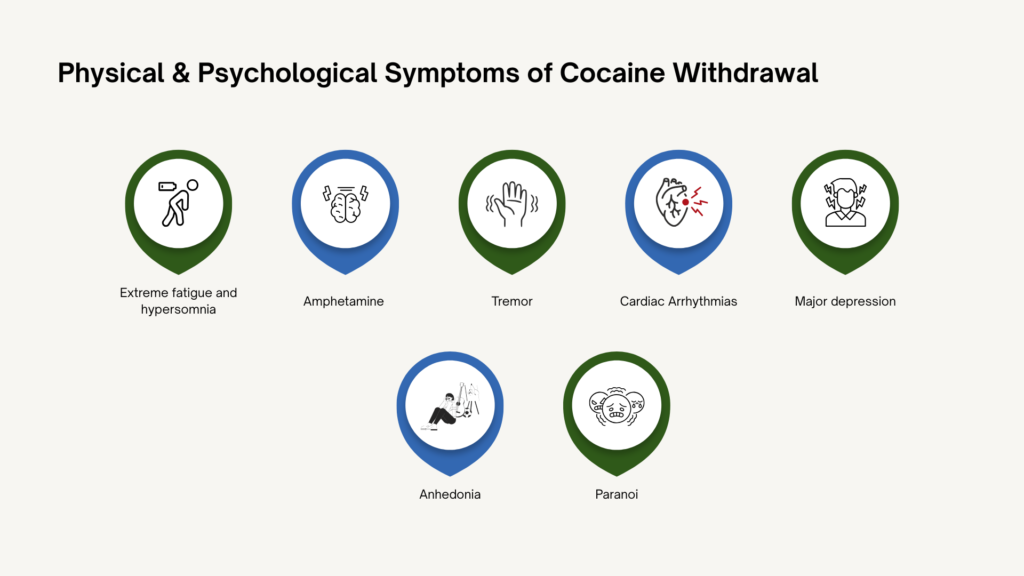
Physical Symptoms of Cocaine Withdrawal
The body responds to cocaine cessation with a distinct set of physical changes:
- Extreme fatigue and hypersomnia
- Amphetamine
- Reduced movement and slow reaction time
- Headaches and muscle aches
- Tremor
- Cardiac Arrhythmias
Psychological and Emotional Symptoms
The psychological symptoms are not just a change in mood, but they can be of a clinically severe nature:
- Major depression (often severe and leading to the need for psychiatric treatment).
- Anhedonia (the lack of feeling pleasure)
- Anxiety and agitation
- Paranoia
- Cognitive impairment
- Sick and vivid dreams
- Suicidal ideation
| Clinical Note: Anhedonia in Cocaine Withdrawal Anhedonia, the inability to feel pleasure, is one of the most debilitating symptoms of cocaine withdrawal. It occurs because cocaine has suppressed the brain’s natural dopamine production. This symptom typically peaks in the first week and gradually improves with abstinence and neurological recovery. |
The “Cocaine Crash”: What Happens Immediately After Use
The cocaine crash is a sudden withdrawal symptom that cannot occur immediately after using cocaine for a few times in the form of binge or during long-term use. As one of our patients put it: “I crashed like falling off a cliff within two hours, I went from feeling invincible to not being able to lift my arms.
The clinical crash manifests as a sudden loss of dopamine, triggering dysphoria (a state of discontent) and overwhelming sedation. Such a crash can take multiple hours to up to 24 hours. At this point, the desire to reuse is greatest. This is when the risk of relapse becomes very high, which is why detox should never be done without medical supervision.
Cocaine Cravings and Post-Acute Withdrawal Syndrome (PAWS)
Acute withdrawal ends, but cravings do not. Post-acute withdrawal syndrome (PAWS) refers to a period of recurring protracted withdrawal symptoms following the last use, typically weeks or months long. For cocaine, PAWS commonly involves:
- Intermittent, high-intensity cravings based on environment (people, places or emotional states)
- Continued anhedonia and low motivation
- Cognitive fog, such as poor memory and executive function
- Depressive and irritable mood instability
Understanding the Cocaine Withdrawal Timeline
When it comes to cocaine withdrawal, there is a timeline that evolves stage by stage.
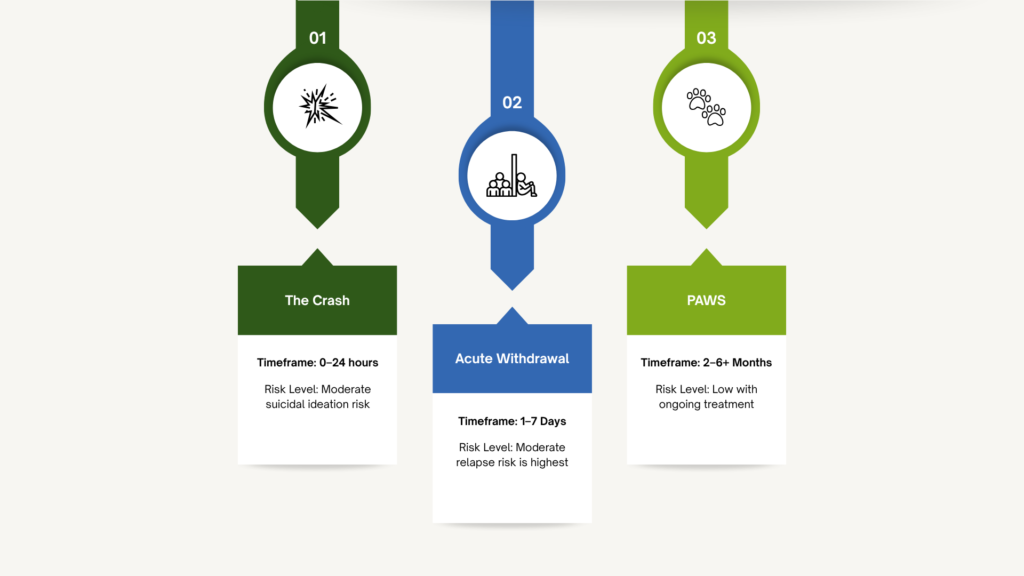
Phase 1: The Crash (Hours 1–24)
For binge users, the crash usually starts 1–2 hours after the last dose, and for daily users a few hours later. It is characterized by some weird and exhaustive sudden vicissitudes. Cocaine kept the neurological reward pathway, which went dark almost right away.
At this stage, the urge to take later has a neurobiological drive. It is an incredibly strong psychological pull from the inside to use. Having medical supervision around the time is useful in providing support and decreasing the risk of immediate relapse.
Phase 2: Withdrawal (Days 1–7)
The majority of recognised withdrawal symptoms peak during this window. Depression usually peaks on days 2–4. Sleep is still disturbed, and insomnia may be interspersed with hypersomnia. This must be a strong desire, especially when stress or unwelcome triggers cause the craving.
This is also when the psychiatric risk is at its highest. Dopamine depletion, disrupted sleep, and cognitive impairment conspire to create circumstances that can lead to suicidal ideation in vulnerable individuals.
Phase 3: Extended Withdrawal (Weeks 2–10)
The acute symptoms die down, yet PAWS (Post-Acute Withdrawal Syndrome) sets in. Emotional regulation remains fragile. Cravings are no longer a constant; they come in episodes, but when they do, they are intense.
Both those who have gone through this phase feels on a survival mode. Weeks 3–8 are statistically high-risk timeframes for return to use without structured therapeutic support and without a plan for continued prevention of relapse.
How Long Does Cocaine Withdrawal Last?
Symptoms of acute withdrawal from cocaine usually resolve over a period of 1–2 weeks. In heavier users, the PAWS-related symptoms, such as mood dysregulation, cognitive challenges, and episodic cravings, can last for 10 weeks or more.
Recovery of the nervous system (including increased dopamine receptor sensitivity) takes months. Neurological recovery after cocaine use disorder takes years rather than weeks.
Is Cocaine Withdrawal Dangerous?
Yes. Cocaine withdrawal does not usually produce seizures or life-threatening physical symptoms as seen with alcohol or benzodiazepine withdrawal. It is the psychiatric aspect that poses the greatest risk.
Medical Risks: Suicide Risk and Psychiatric Episodes
The psychiatric morbidity associated with cocaine toxicity is widely recognized and documented. Instead, severe depressive episodes, thoughts of suicide, and psychotic symptoms can evolve.
For those with a background of depression, bipolar disorder, or prior suicidality, attempting cocaine detox without medical supervision and psychiatric attention is genuinely mortal.
Why Cocaine Withdrawal Is Different from Opioid or Alcohol Withdrawal
These physical effects of opioid withdrawal include vomiting, sweating, muscle cramps, and legs radiating off the spine in all directions; all medically unpleasant but rarely life-threatening in healthy adults. Seizure risk in alcohol withdrawal could be fatal. Cocaine withdrawal belongs in a different classification: predominantly the psychiatry field, where the greatest risk is severe enough depression to result in self-harm.
Can You Detox from Cocaine at Home?
Many people try. Many do far worse than they expect. Many relapse in the first 48 hours, not from lack of motivation, but because the biology of cocaine withdrawal creates circumstances that willpower alone cannot circumvent.
What Medically Supervised Detox Provides
Clinical detox provides: monitoring, medically-assisted care of withdrawal symptoms, psychiatric oversight, and the removal of access to the substance. Medically supervised detox doesn’t merely improve the quality of withdrawal; it alters the result. When comparing, completion rates at clinical detox far exceed home-based attempts.
What to Expect During Cocaine Addiction Recovery | MD Rehab Approach
Detox is not the treatment, as it is the first step. MD Rehab’s continuum of care is based on what empirically works to treat cocaine use disorder clinically, structurally and pragmatically.
| Program | Schedule | Best For | Duration |
| Medical Detox | 24/7 clinical supervision | First 3–7 days of withdrawal | 3–10 days |
| Inpatient / Residential | Full-time, live-in care | Severe addiction, unstable home | 28–90 days |
| PHP | 5–6 hrs/day, 5 days/wk | Post-detox, structured support | 4–8 weeks |
| IOP | 3 hrs/day, 3–5 days/wk | Stable home, flexible schedule | 8–16 weeks |
Medical Detox and Stabilization
At MD Rehab, our medically supervised detox continues this care around the clock, with constant monitoring from a clinical team highly trained in stimulant withdrawal. You have a psychiatric assessment built in from the first day.
Inpatient Residential Treatment for Cocaine Addiction
By taking the person completely out of their using environment and placing them into a structured clinical care setting, inpatient residential rehab provides time to focus on addressing various issues. This is the level of care for patients with severe cocaine use disorder, those with co-occurring mental health conditions, or a history of unsuccessful outpatient interventions.
Partial Hospitalization Program (PHP) for Cocaine Use Disorder
MD Rehab offers a Partial Hospitalization Program, full-day clinical programming (therapy, psychiatric care, skills) with the patient returning to sober living each evening.
Intensive Outpatient Program (IOP)
The Intensive Outpatient Program (IOP) serves patients who require ongoing clinical support after treatment, allowing them to maintain their work, family, and community obligations. Typical IOP consists of 9–12 h per week of programming based on therapeutic modalities and peer support.
Dual Diagnosis Treatment
Our Dual Diagnosis Treatment provides both psychiatric care and addiction treatment on the same clinical team. This is not an adjunct service, but a clinical necessity for true recovery.
Therapy Approaches Used at MD Rehab (CBT, Contingency Management)
- Cognitive Behavioral Therapy (CBT)
- Medication-Assisted Treatment (MAT)
- Contingency Management (CM)
Building a Long-Term Sobriety Plan
The time period immediately following formal treatment is the statistically highest-risk window for relapse. A long-term sobriety plan addresses:
- A structure for step-down care (data from inpatient to PHP to IOP to outpatient)
- Relapse prevention planning
- Ongoing peer support (NA, SMART Recovery, alumni programs)
Get Help for Cocaine Withdrawal Before It Gets Worse
MD Rehab’s team is available now to assess your situation and help you understand the right level of care.
How long does cocaine withdrawal last?
Acute cocaine withdrawal will generally resolve in 7–14 days. Despite this, heavy users can suffer from episodic cravings, mood instability, and cognitive difficulties for up to 10 weeks or longer.
What type of treatment is best for cocaine addiction?
Among the treatment modalities available for severe cocaine use disorder, inpatient residential treatment is the most structured. Partial Hospitalization Programs (PHP) and Intensive Outpatient Programs (IOP) offer more flexibility as highly intensive care.
What are the most common cocaine withdrawal symptoms?
Common symptoms include fatigue, depression, strong drug cravings, increased appetite, sleep disruption, insomnia, anger, irritability, or trouble concentrating. Severe cases can involve extremely severe anhedonia, paranoia, and suicidal ideation.
Is there medication for cocaine withdrawal?
No medication for cocaine withdrawal is approved by the FDA. But drugs can be used to help treat particular symptoms.
How does IOP treatment help with cocaine recovery?
Intensive Outpatient Programs offer structured therapeutic support usually 9–12 hours per week but allow the person to resume daily responsibilities.